
《自律養生實踐家之旅401》 醫療風險再評估
一位住院醫師,接受了五年訓練,距離完成約翰霍普金斯醫院的住院醫師培訓僅剩兩年,卻在此刻做出震撼全場的決定,放棄醫學院替他劃好的從醫之路。
六年多前,我第一次聽見他的演講。真誠與反省滲透在每句話裡,我聽得動容,也在自己的講座中分享他的故事:他在急診室曾責備一位糖尿病患,語氣中帶著輕蔑與指責。
「如果你聽到我今天的演講,請接受我的道歉。」這是他在〈萬一我們對糖尿病的一切理解都錯了?〉的演說中,向當年的病患低頭認錯的那句話。
「你不需要我的評判,也不需要我的鄙視;你需要的是我的理解與同情。」他道歉的並不只是一時的傲慢,而是代表整個醫療體系向病患認錯,因為病情失控,往往不是病人的錯,而是醫療的處置出了問題。
在面對病痛時,談「誰對誰錯」沒有太大意義;真正有意義的,是找到應該負責的人,將責任放回真正的位置。
長期觀察醫療體系的「承擔」與「不承擔」,我深深感受到:真正有勇氣承擔錯誤的人,會像這位醫師一樣在懸崖前煞車,而不是死守在那張本就承載不了真相的椅子上。
他,就是彼得.阿提亞,一位從醫療體制跳脫的人,一位洞察力與覺醒力極強的學者。
他還在住院醫師訓練階段,就已看見自己所受的專業教育漏洞百出。我們可以想像:像他這樣覺察醫療謬誤的醫學生一定不少;甚至進入臨床後才驚醒的人也不會少。
但像阿提亞這樣:義無反顧、轉身離開傳統醫療體系的,又有幾人?
今年,他的重量級巨著《超預期壽命》(Outlive)問世。閱讀原文時,我對書中提出的「風險論」深有共鳴:我們共同看到的,是同一個大問題,接受醫療處置的風險,往往遠高於不接受醫療處置。
他說:「在銀行界,信貸風險研究是一門科學,縱使不完美;在醫學界,風險同樣重要,但醫療對風險的處理多半情緒化,而非科學化。」
當你聽到他以「情緒面」描述一項應該理性分析的工作,你或許無感;但我會立刻想起太多病例:情緒,是醫院裡最深的暗流。
而這些情緒不只來自病人與家屬,也來自醫護。
當年在急診室,阿提亞面對一位因糖尿病而即將截肢、傷口惡臭的病患時,他的內心充滿情緒:嫌棄、失望、責怪病人不遵醫囑。
多年後,他卻在書裡猛烈批判醫療系統對病人的傷害。他直言:「醫學生的『不製造傷害』宣誓,是一種極為諷刺的負擔。」
他指出:「最好的治療方案,往往是沒有立即風險的方案,也就是什麼都不做。」
這其實與許多日本醫師「不治療就是最好的治療」的觀點不謀而合。
病人之所以認為藥物有效,往往是「安慰劑效應」,或只是症狀被暫時壓下。但從病人的角度出發,這正是最大的風險來源,我在講座中形容這是一種「從眾效應」,也是一種「集體偏見」。
失智症被許多學者形容為席捲全球的大風暴,我看見的不是只有腦中的類澱粉蛋白堆積,而是人類集體拒絕進步、拒絕反省。
在全球大量施打新冠疫苗後,我聽到無數國外學者的預言:兩三年後的大量猝死、延後發生的器官衰竭、莫名其妙的身體失常。
這不是事後諸葛,當一支針劑既無法預防感染、也無法降低傳染,為何還要打?
答案很殘忍:當人沒有自己的判斷,只能被別人的判斷帶著走,多少生命因此消失。
醫療體系當時有做「風險評估」嗎?或許有,但問題是:那是真正的風險評估嗎?還是只是一場情緒化、政治化的表演?
在阿提亞的演講裡,我聽見他對自己傲慢的懺悔;但更想問的是:你身邊所熟悉的醫師:他們對病人的態度謙卑嗎?他們對藥物治療的風險,有給予真正的同理與說明嗎?
如果你的部屬「成事不足、敗事有餘」,你會放心把任務交給他嗎?這不就是我們日常生活中最基本的風險評估?
成功率多少?失敗率多少?代價是什麼?
阿提亞在書中談「快速死亡」與「慢速死亡」:醫療對前者很有效率,卻在後者徹底失能。
我能說的只有一句:施力點錯了。因為醫病雙方的動機,從來都不是解決問題,而是滿足慾望。
醫師的慾望、病人的慾望,交織成一段共同的風險故事。
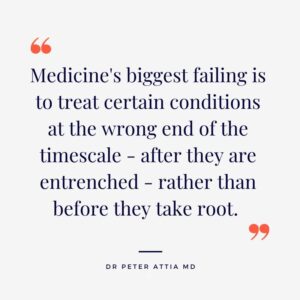
(醫學最大的失敗之一,是總在錯誤的時間點介入——等疾病已深深扎根才開始處理,而不是在它萌芽之前就加以阻止。)
Reassessing Medical Risk
A resident physician—after five years of training and only two years away from completing his residency at Johns Hopkins Hospital—made a decision that shocked everyone: he walked away from the medical career that had been perfectly paved for him.
More than six years ago, I heard his lecture for the first time. Every sentence was infused with sincerity and self-reflection. I was deeply moved and later shared his story in my own talk: he once scolded a patient with diabetes in the emergency room, speaking with disdain and blame.
“If you are listening to my talk today, please accept my apology.”
This was the line he used in his speech titled “What If We’re Wrong About Diabetes?”—a public admission of fault directed to that patient years later.
“You didn’t need my judgment. You didn’t need my contempt. What you needed was my understanding and compassion.”
His apology was not just for a moment of arrogance—it was, symbolically, an apology on behalf of the entire medical system. When a condition spirals out of control, it is often not the patient who has failed, but the medical intervention itself.
When confronting illness, debating “who’s right and who’s wrong” means little. What truly matters is identifying who should be held accountable—and placing responsibility where it belongs.
After years of observing medicine’s patterns of “owning” and “dodging” responsibility, I’ve found that those with genuine courage will, like this physician, slam on the brakes at the cliff’s edge instead of clinging to a chair that was never designed to bear the weight of truth.
That physician was Peter Attia—a man who stepped outside the medical system, a scholar of profound insight and rare clarity.
Even during his residency, he could already see the flaws riddled throughout his professional training. We can easily imagine: there must be many medical students who notice these contradictions; many more who wake up to them only after entering clinical practice.
But how many, like Attia, would turn their backs on traditional medicine without hesitation?
This year, he published his landmark work Outlive. While reading the original text, his “risk-based framework” resonated deeply with me: the risks of receiving medical intervention often exceed the risks of not receiving it.
He writes:
“In banking, credit-risk modeling is a science—even if imperfect.
In medicine, risk is just as important, yet our handling of it is largely emotional rather than scientific.”
You might feel indifferent when he uses the word “emotional” to describe work that should be rational. But I immediately recalled countless cases: emotion is the deepest undercurrent in every hospital.
And this emotion comes not only from patients and families—but from physicians and nurses as well.
Back in the ER, when Attia confronted a diabetic patient with a foul-smelling, soon-to-be-amputated wound, he was overwhelmed with emotion: disgust, disappointment, and the impulse to blame the patient for “non-compliance.”
Years later, he forcefully criticized the medical system’s harm toward patients.
He wrote:
“The Hippocratic oath of ‘do no harm’ is, in many ways, an ironic burden.”
He pointed out:
“The best therapeutic option is often the one with no immediate risk—meaning, doing nothing.”
This aligns remarkably with many Japanese physicians who advocate: “The best treatment is often no treatment.”
Patients often believe a medication “works” when what they are experiencing is merely a placebo effect—or temporary symptom suppression. But from the patient’s standpoint, this becomes the greatest source of risk. In my own talks, I often describe this as a herd effect, a collective bias.
Many scholars describe dementia as an incoming global storm.
What I see is not only amyloid plaques in the brain—but humanity’s collective refusal to evolve, to reflect.
After the mass rollout of COVID vaccines, I heard countless predictions from international researchers: sudden deaths two or three years later, delayed organ failure, unexplained physiological collapse.
This was not hindsight. When an injection neither prevents infection nor reduces transmission, why insist on administering it?
The answer is brutal:
When people lose the ability to judge for themselves, they can only follow other people’s judgments—and countless lives disappear as a result.
Was there “risk assessment” by the medical system at that time?
Perhaps.
But the real question is: Was it genuine risk assessment—or a theatrical performance shaped by emotion and politics?
In Attia’s talk, I heard his remorse for past arrogance.
But what I want to ask is this:
What about the physicians you personally know?
Are they humble toward their patients?
Do they truly explain the risks of medications with empathy and honesty?
If your subordinate is “more likely to spoil things than complete them,” would you entrust them with important tasks?
Isn’t this the most basic form of risk assessment in daily life?
What is the success rate?
What is the failure rate?
And what will it cost?
In Outlive, Attia speaks of “fast death” versus “slow death”: medicine is efficient with the former, and utterly powerless with the latter.
All I can say is this:
The point of force is misplaced.
Because neither the physician nor the patient is driven by the desire to solve problems—they are driven by desire itself.
The desires of the physician and the desires of the patient intertwine to form a single, shared story of risk.


