
《自律養生實踐家之旅426》 三分之一
兩個人要分財產,怎麼分最恰當?如果由財產擁有人決定,一人一半似乎是最公平的分法。至於這樣的分配是否真正公平,分到財產的兩方,終究會有各自不同的領受。
我在一間港式飲茶餐廳裡,領悟一種生命哲理。四個人共餐,桌上點了一份蝦餃,偏偏只有三顆。其中一位主動請另外三位食用。那一刻,我看到的重點不只是禮讓,而是「主動」。
謙讓,是人際關係中備受敬重的情操。「孔融讓梨」的故事之所以流傳至今,歌頌的正是主動的謙讓。人與人之間,總會不斷上演禮讓與計較的分庭抗禮,而真正能被記住的,往往不是誰拿得多,而是誰願意先退一步。
知道父親立下遺囑的大哥,曾主動向父親提出,願意禮讓小弟。理由是,父親過去已投注可觀的成本栽培他。後來,父親果然只留給大哥三分之一。
三分之一,忽然成為一種值得深思的尺度。
它不是絕對的均分,卻像是各種生命現象所演出的平衡法則。一天二十四小時,我們有三分之一的專注階段,也有另外三分之一必須全然繳械,交還給睡眠。剩下的三分之一,則是最容易被忽略、卻也最值得珍藏的緩衝地帶。
不論學習或工作,每天真正能善用的精華,大約就是八小時,也就是一天的三分之一。當我們長期超時工作,這份精華很快會變成耗損;若再繼續侵蝕睡眠的八小時,健康遲早會亮起紅燈。
嚴格說來,白天與夜晚在地球大部分地區接近均分,可是體內設定給睡眠工程的時間,依然維持在三分之一,也就是八小時。
除去工作與睡眠,另外的三分之一,留給緩衝、轉換、休閒與整理。這是兩種極端之間的平衡地帶,也是生命不至於被壓扁的重要空間。
如果睡眠有意識,它不會為自己爭取更多時間。事實上,它一直都在禮讓。問題從來不是睡眠貪心,而在清醒世界的不斷侵占與掠奪。
在懷孕婦女腸道菌相的研究觀察中,三分之一的分配,再度被演繹得淋漓盡致:前三分之一為新生兒,後三分之一是母體的大愛與犧牲,至於中間三分之一,則是菌相的轉換與交接。
三分之一是否存在謙讓的修養?大自然似乎一直都有合乎人性的解釋。只是,當人類把一天的三個階段連結到餐桌上,我們是否也有機會重新思考一日三餐的合理性?
用餐究竟是身體需要,還是口腹之慾駕馭了身體的需求?如果飲食是口慾與身體之間的妥協,那麼放大來看,人類的飲食面向究竟是身體謙讓了,還是口慾禮讓了?
在與自己的身體對話十年之後,我主動把用餐頻率退守至每日一餐。這個謙讓的動作,其實來得太晚。因為身體早在對話初期,就不斷釋放過度飲食的訊息。
一日一餐,對我而言,符合三分之一的謙讓守則。這裡所謂的一餐,指的是熟食;而這一餐熟食的範圍,當然也可以包含並接納生食。
每一位真正理解身體承受與需求的人,都會主動對身體釋放誠意。至於如何在身體需求與生理慾望之間取得平衡,不妨透過一個月三十天來思考。
如果身體主動謙讓,給我們三分之二的餵食享受,已經誠屬合理。換句話說,對懂得斷食的人而言,月斷食計畫若以三分之一作為尺度,就是十天。
如果你能自律的守住與身體合作的互重計畫,每個月固定淨化斷食七天,已是相當可貴的實踐;若以週休作為比喻,週休一天的人,可以思考每月七天的斷食節奏;若是力行週休二日的人,例行性的淨化斷食則可考慮五天。這是我個人的執行方案,也是我與身體合作之後理出的平衡方式。
每個月讓身體休息十天,對場外的人來說或許是很大的損失;可是對理解身體運作原則的你我來說,這不只是謙讓,更是為自己的健康負起責任的覺悟。
除垢營開辦後,我赫然發現,有些學員幾乎每次活動必到。他們並非走火入魔,而是已經擁有每個月主動讓身體休息的體悟。他們成為淨化身體的典範,也成為身體之道最安靜、卻最有說服力的見證。
初期,他們也許各有各的動機;可是當一個人持續對身體釋出最大的善意,身體的回應終究會在執行者身上留下印記。
我在來來去去的人身上觀察並記錄,即知即行的人,往往同時攜帶「以終為始」的視野。他們最終都建立起身體視角,對照為數眾多、始終停留在大腦視角的人們,差別十分清楚。
人生大抵也是這麼一回事,不是到了最後才回顧,就是在這一刻先看到最後。前者終於意識到,生命是如何浪費掉的,這是悔恨的劇本;後者則是慶幸的劇本,因為他們提前把辛苦的歷程先走過,也提前為未來留下可貴的時間和空間。
睡眠的設定告訴我們:沒有三十年的床上入眠,就不會有九十歲的壽命。前三十年的成熟教育,幾乎栽培出另外六十年的人生格局。多數人的一生,其實都在前三分之一決定成敗,讓我更加領悟,家教是人生的基石。
我也告訴自己,人生或許只剩下不到三分之一的時光。要如何謹守這生命最後的三分之一,關鍵一定在餘生的前三分之一,也就是我宣導身體之道最關鍵的十年。
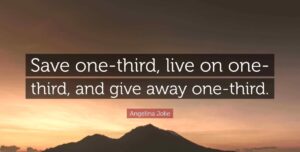
安潔莉娜・裘莉有一句常被引述的話:「存下三分之一,靠三分之一生活,再把三分之一捐出去。」
三分之一,多麼有哲理的尺度;三分之一,多麼有節制的紀律。
三分之一,也許正是生命提醒我們:真正的富足,不在於佔有全部,而在於懂得留下、懂得使用,也懂得給予。
有人說:「寫作靠三分之一想像、三分之一經驗、三分之一觀察」,一點都沒錯。
(三分之一用來儲蓄,三分之一用在生活,三分之一用於奉獻。)
One Third
When two people are to divide an inheritance, what is the fairest way to do it? If the owner of the property were the one to decide, splitting it equally in half would seem to be the fairest arrangement. As for whether such a division is truly fair, the two parties who receive it will ultimately have their own different feelings about it.
In a Hong Kong-style dim sum restaurant, I once came to understand a philosophy of life. Four people were dining together. On the table was an order of shrimp dumplings, yet there were only three pieces. One person took the initiative and invited the other three to eat them. In that moment, what I saw was not merely courtesy, but initiative.
Humility and yielding are virtues highly respected in human relationships. The story of Kong Rong giving up the larger pears has been passed down precisely because it praises this kind of proactive humility. Between people, the struggle between yielding and calculating is constantly being played out. Yet what is truly remembered is often not who received more, but who was willing to take the first step back.
The eldest brother, knowing that his father had made a will, once took the initiative to tell his father that he was willing to yield more to his younger brother. His reason was that his father had already invested considerable resources in cultivating him. Later, his father did indeed leave only one-third to the eldest son.
One-third suddenly became a measure worthy of deep contemplation.
It is not an absolute equal division, yet it seems to resemble a law of balance performed by many phenomena in life. In a day of twenty-four hours, we have one-third for focused activity, and another one-third in which we must completely lay down our defenses and return ourselves to sleep. The remaining one-third is the buffer zone most easily overlooked, yet most worthy of being cherished.
Whether in learning or work, the essence of what we can truly make good use of each day is roughly eight hours, which is one-third of a day. When we work overtime for long periods, this essence quickly turns into depletion. If we continue to erode the eight hours meant for sleep, our health will sooner or later flash a warning light.
Strictly speaking, day and night are nearly equal in most parts of the earth. Yet the time internally assigned to the engineering of sleep remains one-third, which is eight hours.
Apart from work and sleep, the other one-third is left for buffering, transition, leisure, and restoration. This is the balancing ground between two extremes, and it is also the important space that prevents life from being flattened.
If sleep had consciousness, it would not fight for more time for itself. In truth, it has always been yielding. The problem has never been that sleep is greedy, but that the waking world keeps encroaching upon it and taking from it.
In observational studies of the gut microbiota of pregnant women, the distribution of one-third is once again performed with remarkable clarity: the first one-third is for the newborn, the last one-third is the mother’s great love and sacrifice, and the middle one-third is the transition and handover of the microbiota.
Does one-third contain the cultivation of humility? Nature seems to have always offered an explanation that is deeply aligned with humanity. Yet when human beings connect the three stages of a day to the dining table, do we also have the chance to reconsider the reasonableness of three meals a day?
Is eating truly a bodily need, or has appetite taken control of the body’s needs? If diet is a compromise between oral desire and the body, then from a broader view, has the body yielded to appetite, or has appetite yielded to the body?
After ten years of dialogue with my own body, I proactively retreated my eating frequency to one meal a day. This act of yielding actually came too late. From the early stages of our dialogue, my body had already been repeatedly releasing messages about excessive eating.
One meal a day, to me, conforms to the rule of one-third humility. By “one meal,” I am referring to cooked food; and of course, this cooked meal may also include and embrace raw food.
Anyone who truly understands the body’s burden and needs will proactively express sincerity toward the body. As for how to find balance between bodily need and physiological desire, perhaps we may think through the frame of thirty days in a month.
If the body proactively yields and gives us two-thirds of the month for the enjoyment of feeding, that is already more than reasonable. In other words, for those who understand fasting, if a monthly fasting plan takes one-third as its measure, that would be ten days.
If you can self-disciplinely uphold a mutual-respect plan in cooperation with your body, then setting aside seven days each month for cleansing fasts is already a very valuable practice. If we use the idea of weekly rest as an analogy, someone who takes one day off each week may consider a rhythm of seven fasting days per month; someone who faithfully observes two rest days each week may consider a regular cleansing fast of five days. This is my personal method of practice, and also the balance I have clarified through cooperation with my body.
Allowing the body to rest for ten days each month may seem like a great loss to those standing outside the field. Yet for you and me, who understand the principles of bodily operation, this is not merely humility. It is an awakening of responsibility for one’s own health.
After Selfasteam Camp was launched, I was struck by a discovery: some participants attended almost every session. They were not fanatics. Rather, they had already developed the realization of proactively allowing the body to rest every month. They became examples of bodily cleansing, and also the quietest yet most persuasive witnesses to the body’s way.
At the beginning, they may each have had their own motives. Yet when a person continues to offer the greatest goodwill to the body, the body’s response will eventually leave its imprint upon the practitioner.
As I observe and record those who come and go, I find that those who understand and act immediately often also carry the vision of “beginning with the end in mind.” In the end, they all establish a bodily perspective. Compared with the many who remain trapped in the perspective of the brain, the difference is unmistakably clear.
Life is largely like this as well. Either we wait until the end to look back, or we first see the end in this very moment. The former finally realizes how life has been wasted; this is the script of regret. The latter lives the script of gratitude, because they have walked the difficult road ahead of time, and have also preserved precious time and space for the future.
The setting of sleep tells us this: without thirty years of sleeping in bed, there will be no ninety-year lifespan. The mature education of the first thirty years almost cultivates the pattern of the next sixty years of life. For most people, success or failure is actually determined in the first one-third of life. This makes me understand even more deeply that family education is the cornerstone of life.
I also tell myself that perhaps less than one-third of my life remains. How I am to guard this final one-third of life must depend on the first one-third of my remaining years — namely, the most crucial ten years in which I advocate the body’s way.
Angelina Jolie has a frequently quoted saying: “Save one-third, live on one-third, and give away one-third.”
One-third — what a philosophical measure.
One-third — what a disciplined form of restraint.
One-third may be life’s way of reminding us that true abundance does not lie in possessing everything, but in knowing what to keep, knowing how to use, and knowing how to give.
Some say, “Writing depends on one-third imagination, one-third experience, and one-third observation.”
They are absolutely right.


