
《自律養生實踐家之旅434》 人生最大的恐懼根源,是失去自己
我曾經長期訂閱《商業周刊》、《遠見》和《天下雜誌》。那是我四十歲到五十歲之間的階段。這些都是很有內容的雜誌,也確實拓展過我的視野。直到有一天,我突然有所覺悟,於是停下了這類雜誌的訂閱和閱讀習慣。
我發現,它們所形塑的成功和我真正想走的人生並不一定會有交集。每當我閱讀那些成功故事時,思緒總是不知不覺被帶往一種不屬於我的版圖。那裡有光鮮的成就、有被放大的掌聲,也有某種讓人誤以為必須追趕的焦慮。
我深信,對於正處於青壯年、又懷抱創業企圖的人來說,事業成功確實是巨大的誘因,也是努力的目標。然而,這樣的聚焦,也可能在不知不覺中製造更大的失焦。
我不是否定成功,也不是批評媒體對成功的行銷與描繪。我真正關注的,是價值觀的重建,是一個人能否對自己、對自己的身體,有更精準、更誠實的探索。
換一個角度來看,若我們調查八十歲以上的人,還有多少人習慣閱讀這類成功雜誌?答案或許不難想像。重點不是這些內容對他們毫無意義,而是走到那個年紀的人,價值觀多半已經歷某種沉澱。他們眼觀八方,看過得失,也看過成敗,甚至看過年輕時曾經執著的一切,清楚自己錯過了什麼。
或許帶著一些遺憾,也或許藏著某些悔恨,當生命即將畫下休止符時,人才會真正明白:如果人生能早一點守住自己的價值,如果能早一點把身體經營得很成功,那該有多好。
我們應該把身體視為一個屬於自己的企業版圖,器官,是分布各處的據點;各大系統,是功能不同的營運單位。而這個企業的成功指標,絕對不是營業額,因為它無價。
當你真正領悟健康無價,你就會排除萬難去經營這個企業。因為它不會被收買,不會被併購,也不會有人透過每天的交易盤,為你貼上價格標籤。
「無價」不難懂,「很重要」也常常掛在嘴邊。可是,人最大的困境,往往就在於裝傻,而裝傻的某一種呈現,就是裝懂。這個世界到處都是嘴巴很會講,卻始終做不到的人。
我也曾經處在裝懂的狀態,憑藉著自己能寫、也能說,以為那就是理解。直到我必須站在講台上,面對各種疑難雜症,才發現那不過是一層虛假的包裝。
自己是真,還是假,有時候連自己都搞不清楚。有些演員演戲演到回不到自己,有些人則是一輩子都在扮演一個虛假的自己。
類似的議題不容易搬到檯面上,一不小心就會落入爭辯。為什麼老人家的價值觀比較清晰,也比較客觀?因為他們已經沒有太多力氣爭辯,辯論在生命的後段早已失去意義。
我曾經試圖在一群完全狀況外的人面前,解釋何謂傾吐,以及何謂脫掉偽裝。結果,因為多數觀眾並沒有準備好接受傾訴,反而讓說真話的人陷入一種穿上國王新衣般的尷尬。
那次經驗給了我更深的提醒,我告訴自己,也許我還不具備把這類議題拉上檯面的功力。換一個角度看,教什麼,終究還得看學習者是否有能力吸收。
養生最難、也最深奧的題材,其實不在身體,而在自己。最懂這種局面的人,或許是訪談時間夠長、個案經驗夠豐富的諮商師。只有他們深知人的複雜與虛假,也只有他們真正理解面子與身段的存在。
人類世界有一種大面積的失焦,證據就顯現在醫療場域的人滿為患。那是一種我行我素的傲慢展現,同時也是一種人云亦云、魂飛魄散的集體狀態。
若只用對錯來論述醫病雙方,似乎並不合情理。可是,當你從「人如何遠離自己」這個現象深入觀察雙方的演繹,就會發現,人類世界的恐嚇遊戲,以及恐怖人性所堆疊出來的,正是一座恐懼的集合體。
這是一個超級大漩渦,也許你還沒有感受到自己被捲進去的威脅,可是,就在你被某一則成功故事吸引的那一刻,漩渦可能早已離你不遠。
憂鬱症成為文明世界的重大困境之一,或許正來自人類思考上的巨大迷陣。它來自太多人不再是自己,也就是說,真正的自己與虛假的自己早已深度不相容,而那個虛假的自己,卻依然處於主導位置。
以我個人的觀察與體會,「為錢做事」是失去自己的主幹道。這種動念存在於民間每一個角落。從「應該有一份工作」,到「下個月的生活費在哪裡」,我們一路被訓練成迎合別人的狀態。
生命與養生議題真正結合,累積在我這些年的工作足跡。我領悟到一種超出一般意識層級的道理:我們不應該為恐懼做事,更不應該讓恐懼成為做決定的動機。
因為生命不是這樣運作的,生命的豐盛,足以滿足一個人的合理需求。我們沒有必要把恐懼奉為主人,更不應該讓他人的意念綁架自己的人生。
我曾經對身旁的人說:「生命不會為難你」,後來我發現,問題不在於聽不聽得懂,而在於相不相信。那必然是幾十年人生觀念錯置之後的結果,我們在別人的指令中活得太久,失去了和自己在一起的練習。
那些你曾經害怕他們會生氣的人,那些你曾經極力討好的人,那些你為了不讓他們失望而委屈自己的人,也許都曾經在你的生命裡佔據過巨大的位置。
我談的不是孝順或不孝順,也不是忠誠或不忠誠。我談的是:因為他們,你一直扮演別人的附庸,而這種局面將會終結你的性命。
一個人這一生最應該守住的價值,不正是自己存在的意義嗎?
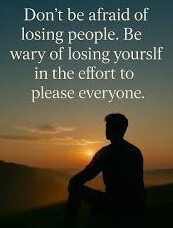
(不要害怕失去別人,真正需要警覺的是:為了取悅每一個人,而逐漸失去了自己。)
The Deepest Root of Fear in Life Is Losing Yourself
I once subscribed for many years to Business Weekly, Global Views Monthly, and CommonWealth Magazine. That was during the period between my forties and fifties. These were all magazines of real substance, and they did broaden my perspective. Yet one day, I suddenly came to a realization, and I stopped subscribing to and reading this kind of publication.
I discovered that the version of success they portrayed did not necessarily intersect with the life I truly wanted to live. Whenever I read those success stories, my thoughts would unconsciously be drawn toward a territory that did not belong to me. There were dazzling achievements there, amplified applause, and a certain anxiety that made people mistakenly believe they had to keep chasing.
I deeply believe that, for those in the prime of life who carry entrepreneurial ambition, career success is indeed a powerful incentive and a goal worth striving for. Yet this kind of focus may also, without one noticing, create an even greater loss of focus.
I am not denying success, nor am I criticizing the way media markets and depicts success. What I truly care about is the reconstruction of values: whether a person can explore himself and his own body with greater precision and honesty.
Seen from another angle, if we were to survey people over the age of eighty, how many of them would still be in the habit of reading this kind of success magazine? The answer is perhaps not difficult to imagine. The point is not that such content has no meaning for them, but that by the time people reach that age, their values have usually gone through a certain kind of settling. They have looked in all directions. They have seen gain and loss, success and failure, and even the very things they once clung to in youth. They know clearly what they have missed.
Perhaps with some regret, or perhaps with certain remorse hidden deep within, when life is about to draw its final pause, a person may finally understand: how wonderful it would have been if he had guarded his own values earlier, and if he had learned earlier to manage his body successfully.
We should regard the body as an enterprise territory that truly belongs to us. The organs are outposts distributed throughout this territory; the major systems are operating units with different functions. Yet the success indicator of this enterprise is absolutely not revenue, because it is priceless.
When you truly realize that health is priceless, you will overcome every obstacle to manage this enterprise well. Because it cannot be bought. It cannot be acquired. And no one can place a price tag on it through a daily trading board.
“Priceless” is not difficult to understand, and “very important” is something people often say. Yet the greatest predicament of human beings often lies in pretending to be ignorant; and one expression of pretending to be ignorant is pretending to understand. This world is full of people who speak well, but never truly do what they say.
I was once in that state of pretending to understand. Relying on my ability to write and speak, I thought that was understanding. It was not until I had to stand on stage and face all kinds of difficult and complicated questions that I realized it was nothing more than a layer of false packaging.
Whether one is real or false, sometimes even the person himself cannot tell. Some actors act until they can no longer return to themselves. Some people, meanwhile, spend an entire lifetime playing a false version of themselves.
Issues like this are not easy to bring into public discussion. One careless step, and they can fall into argument. Why do older people often have clearer and more objective values? Because they no longer have much energy left to debate. In the later stage of life, argument has already lost its meaning.
I once tried to explain, in front of a group of people who were completely outside the situation, what it means to pour oneself out, and what it means to remove one’s disguise. As a result, because most of the audience was not ready to receive such honesty, the person speaking the truth was instead placed in an awkward situation, as if wearing the emperor’s new clothes.
That experience gave me an even deeper reminder. I told myself that perhaps I still did not have the ability to bring this kind of issue onto the stage. Seen from another angle, what one teaches ultimately depends on whether the learners have the capacity to absorb it.
The most difficult and profound subject in health cultivation is not actually the body, but the self. Those who may understand this situation best are counselors who have spent enough time in interviews and accumulated enough experience with individual cases. Only they deeply understand the complexity and falseness of human beings. Only they truly understand the existence of face, posture, and self-protection.
There is a large-scale loss of focus in the human world, and the evidence is clearly seen in overcrowded medical settings. That is an arrogant display of people doing whatever they want, and at the same time, a collective state of following the crowd until the soul itself seems scattered.
If we discuss both doctors and patients only in terms of right and wrong, it does not seem entirely reasonable. Yet when you observe the performance of both sides through the phenomenon of “how people drift away from themselves,” you will discover that the human world’s game of intimidation, and the terrifying layers of human nature built upon it, have formed nothing less than a collective body of fear.
This is a massive vortex. Perhaps you have not yet sensed the threat of being drawn into it. But the moment you are attracted by a certain success story, that vortex may already be closer than you think.
Depression has become one of the major predicaments of the civilized world. Perhaps it arises from the enormous maze within human thinking. It comes from the fact that too many people are no longer themselves. In other words, the true self and the false self have long become deeply incompatible, yet that false self remains in command.
From my personal observation and experience, “working for money” is the main road to losing oneself. This motive exists in every corner of society. From “I should have a job” to “Where will next month’s living expenses come from?” we have been trained, step by step, into a state of pleasing and accommodating others.
The true integration of life and health cultivation has accumulated through the work I have done over these years. I have come to understand a principle that surpasses ordinary levels of consciousness: we should not work out of fear, and we should never allow fear to become the motive behind our decisions.
Because life does not operate this way. The abundance of life is enough to meet a person’s reasonable needs. We have no need to worship fear as our master, nor should we allow the intentions of others to hijack our lives.
I once said to people around me, “Life will not make things difficult for you.” Later I discovered that the problem is not whether people understand this sentence, but whether they believe it. That disbelief is inevitably the result of decades of misplaced values. We have lived too long under the instructions of others, and we have lost the practice of being with ourselves.
Those people you once feared would become angry, those people you tried so hard to please, those people for whom you wronged yourself because you did not want to disappoint them — perhaps they once occupied an enormous place in your life.
I am not talking about filial piety or a lack of filial piety, nor am I talking about loyalty or disloyalty. What I am talking about is this: because of them, you have kept playing the role of someone else’s subordinate, and this situation will eventually bring your life to an end.
What is the value a person should guard most in this life, if not the very meaning of his own existence?


